 |
Click image above to enlarge for detailed viewing. |
Ships in 7 to 10 Days
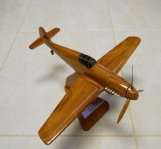
Wingspan 15 inches
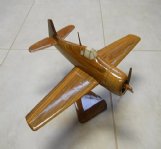
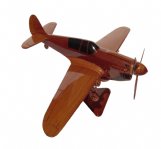
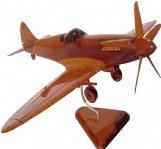
This P51 Mustang mahogany wood Replica is beautifully handcrafted out of reclaimed Mahogany Wood. Each piece is crafted with intense detail and finished with three coats of polyurethane coating that gives it a high gloss finish. This fine work of art takes approximately 18 hours of labor to create. If you are a collector or simply want a fine art piece this mahogany model is sure to enhance your home or office.
The North American Aviation P-51 Mustang was an American long-range, single-seat fighter and fighter-bomber used during World War II, the Korean War and in several other conflicts. During World War II Mustang pilots claimed 4,950 enemy aircraft shot down, second only to the Grumman F6F Hellcat among Allied aircraft.It was conceived, designed and built by North American Aviation (NAA), under the direction of lead engineer Edgar Schmued, in response to a specification issued directly to NAA by the British Purchasing Commission; the prototype NA-73X airframe was rolled out on 9 September 1940, albeit without an engine, 102 days after the contract was signed and it was first flown on 26 October.[3] The Mustang was originally designed to use a low-altitude rated Allison V-1710 engine, and was first flown operationally by the Royal Air Force (RAF) as a tactical-reconnaissance aircraft and fighter-bomber. The definitive version, the P-51D, was powered by the Packard V-1650-7, a licence-built version of the Rolls-Royce Merlin 60 series two-stage two-speed supercharged engine, and armed with six .50 caliber (12.7 mm) M2 Browning machine guns.From late 1943, P-51Bs (supplemented by P-51Ds from mid-1944) were used by the USAAF's Eighth Air Force to escort bombers in raids over Germany, while the RAF's 2 TAF and the USAAF's Ninth Air Force used the Merlin-powered Mustangs as fighter-bombers, roles in which the Mustang helped ensure Allied air superiority in 1944.[4] The P-51 was also in service with Allied air forces in the North African, Mediterranean and Italian theatres, and saw limited service against the Japanese in the Pacific War.At the start of Korean War the Mustang was the main fighter used by the United Nations until jet fighters, including the F-86, took over this role; instead the Mustang became a specialized fighter-bomber. Despite the advent of jet fighters, the Mustang remained in service with some air forces until the early 1980s. After WWII and the Korean War, many Mustangs were converted for civilian use, especially air racing.
|